The AI Paralysis
- Editorial date
- Editorial date
- Blog Post views
- ... Views
- Reading time
- 15 min read
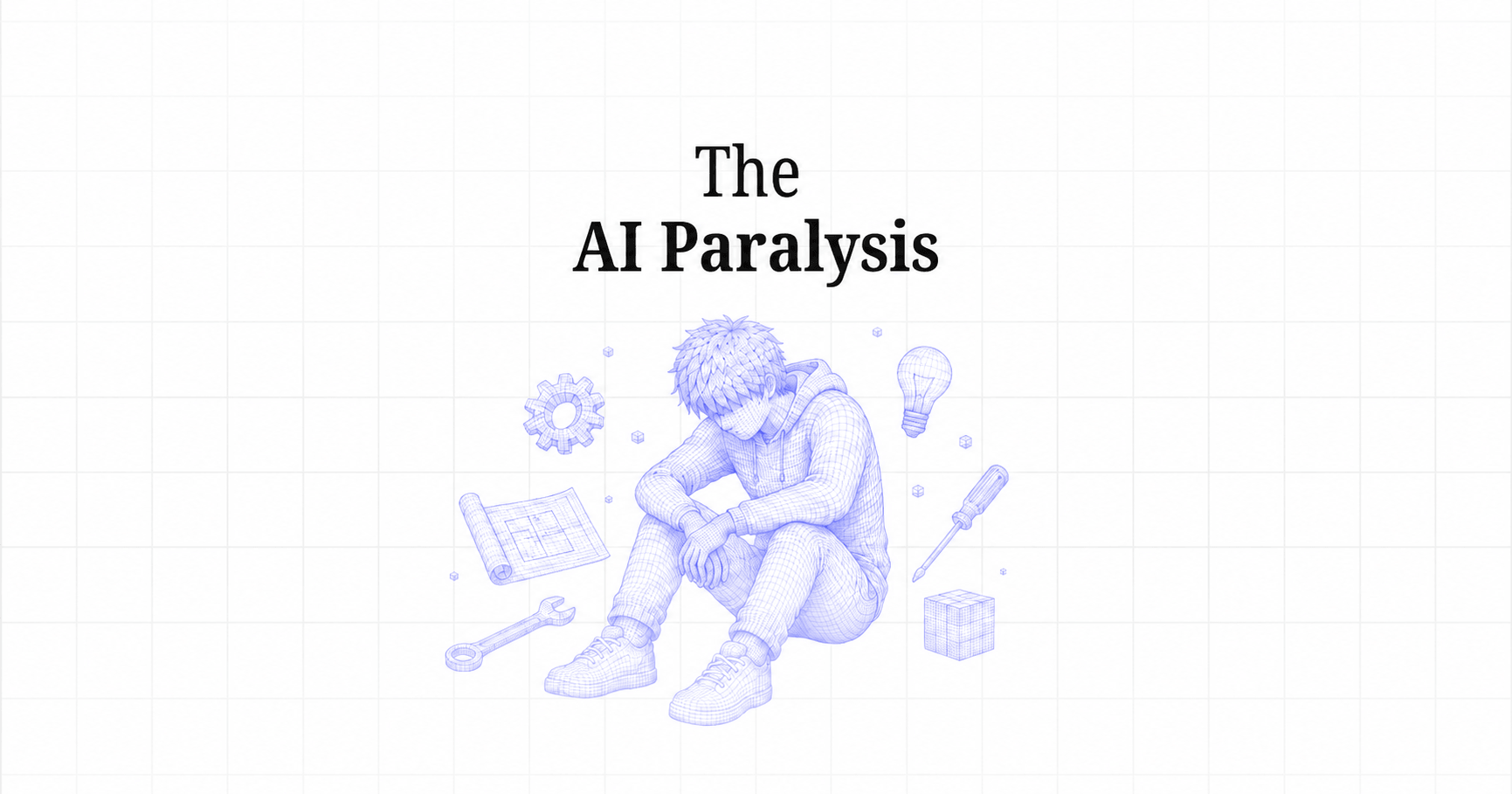
People have stopped thinking.
Not completely. But enough that it's becoming noticeable.
Nowadays what I keep seeing is people replacing more and more of their thinking with AI and calling it productivity.
Nothing I'm saying here is some profound observation.
It's just something I've been noticing around me for a while.
Maybe in the future models get good enough to actually replace me.
But for now, that's not the reality.
So here's the rant.
The Death of Starting
Look at the pre-AI era.
Earlier, only engineers used to think about solving problems with software.
Everyone else assumed software was a long process and something that should be done by people who actually knew the field.
And honestly, that made sense.
If a non-technical person wanted to build something, the path was pretty straightforward.
Let's say they wanted a website.
They would start by learning some HTML, CSS, maybe a little JavaScript. Open WordPress or Blogger. Make something ugly. Break a few things.
Eventually they would ship their first website.
And that's how people started.
Now people don't even think about what they need to learn.
They open ChatGPT.
"How do I make a website?"
"What technology should I use?"
GPT says Astro. Rails. Whatever happens to be recommended.
They take that answer, dump it into their coding tool, generate the output and call it building.
That's the entire process.
The first-principles thinking is gone.
The "let's just build it and figure it out" mindset is gone.
Instead the whole discussion became something else.
- Which model is faster.
- How do I save tokens.
- Which framework did GPT recommend.
- Which agent is better.
- Which stack should I use.
- Which workflow should I follow.
- Which automation should I add.
And then another hundred questions that don't actually matter.
People are not starting anymore because AI created this illusion that there is a perfect path somewhere.
And if you find the right prompt, everything will magically work.
It won't.
You think spending $200 is a lot?
Let me tell you about Garry Tan. The CEO of Y Combinator.
He built a project called Garry's List, fully vibe-coded on Ruby on Rails.
Not a single line written by a human.
AI in the loop.
Not human in the loop. AI in the loop.
Running constantly and generating tens of thousands of lines every day.
He's openly talking about writing 10k lines a day on a codebase that has crossed 300,000 lines.
And the thing barely opens.
The amount of slop piled into that project is insane.
The website is somewhere around 200-300MB.
You click it and wait 20-30 seconds for it to load.
Sometimes it just times out.
Sometimes it never loads at all.
Think about that.
This is someone with practically unlimited funding, unlimited AI access, access to the best founders, the best models and some of the best engineering talent in the world.
And his own blog turned into unusable garbage.
Watch the video for more context
Now imagine people who have none of those advantages.
Less technical.
Less experienced.
More convinced that AI can build anything.
Maybe it can build it.
But then what?
Who maintains it?
Who fixes it?
Who understands it six months later?
Forget code quality.
Forget architecture.
Just answer one question.
How are you going to keep it running?
I know a guy who built a simple to-do app using AI because he didn't want to pay $20 for another app.
Read more about it in this blog: AI Can't Save Bad Engineering
He bought Claude Code Max.
Spent around $200.
Built the app.
Worked perfectly on localhost.
Then he started actually using it.
After five minutes there was a memory leak.
The browser would slowly eat all available memory until the entire thing became unusable.
He fixed that.
Then hydration errors showed up.
Then more issues.
Then even more issues.
Weeks went into fixing the UI.
Weeks went into fixing the model layer.
Nested tasks.
Notes.
Basic functionality.
The kind of stuff mature products solved years ago.
He even tried integrating Alexa and Google Calendar.
Neither worked properly.
All of that effort.
Just to avoid paying $20 a year.
For an app that already existed.
An app that already worked on web, mobile, watch and pretty much every device he owned.
That's the loophole.
People convince themselves everything is one prompt away.
It never was.
If you don't know how to build something without AI, AI is not magically going to save you.
The opposite is usually true.
If you already know how to build something, AI can help you do it much faster.
The capability was already there.
AI just amplified it.
The easiest time to start was when you knew almost nothing. Now people spend months researching a dream they could have started this afternoon.
Thinking Became Optional
People are outsourcing their first-principles thinking to AI.
Or they turn on some thinking mode inside the coding agent and assume the problem is solved.
It isn't.
First-principles thinking is a skill.
The more you use it, the better you get at it.
The more you think, the better decisions you make.
The more you solve problems yourself, the easier it becomes to spot bad ideas, bad trade-offs and bad assumptions.
But if AI is doing all the thinking for you, then you are slowly losing that ability.
And that's where the problem starts.
Every AI model has its own biases. Every model is trained on different data.
Some models are overly positive. Some models are overly negative. Some models will always tell you why something can work. Some models will always tell you why something can fail.
And because of that, the output changes.
The thinking changes.
The recommendation changes.
You never really know what is influencing the answer.
That's why you cannot outsource your thinking.
You cannot outsource your judgement. You cannot outsource your opinions.
Because the moment you do that, you stop producing original ideas.
You stop connecting things yourself. You stop questioning things.
And after some time you can actually feel it.
That slight discomfort when you need to think deeply about something.
That mental pain when you need to sit with a problem for more than a few minutes.
Not because the problem is hard.
Because you haven't been using that muscle anymore.
AI should be a calculator for math, not a calculator for your thoughts.
The scariest thing I have seen is that some people don't even have opinions anymore.
They just have prompts.
Ask them something and their first response is not "let me think about it."
It's "let me ask AI."
That's genuinely concerning. Because at that point you are not thinking.
You are just forwarding questions. I have seen people work like this.
Their entire job becomes prompting.
Prompt.
Copy.
Paste.
Prompt again.
And somehow convince themselves they are doing deep work.
But if you spend the whole day asking AI what to do next, eventually you stop knowing what to do without it.
And that's where people get stuck.
Not because AI replaced them.
Because they slowly replaced themselves.
Some people don't have opinions anymore. They have prompts.
Infinite Possibilities, Zero Commitment
AI makes everything look possible.
You can build a startup in a day.
A new side project tomorrow.
A new niche next week.
A new SaaS next month.
And because everything feels possible, people stop committing to anything.
I keep seeing this happen again and again.
People are shipping projects but have no users.
People are building products but have no understanding.
People are switching niches every few weeks and becoming average at ten different things instead of becoming really good at one thing.
They think they are ahead because they can build fast.
But most of the time they just have very broad knowledge and very shallow understanding.
AI makes everything look easy from the outside.
But you still don't know the hard parts.
You still don't know the trade-offs.
You still don't know why things work.
And most importantly, you still haven't mastered the field.
So even though you can create things faster, your chances of succeeding in that field don't magically increase.
At the end it becomes a weird zero-sum game.
A lot of possibilities.
Very little outcome.
Let's say you actually build that perfect to-do app.
You spent your $200.
You got exactly what you wanted.
Now what?
How are you going to market it?
How are you going to get users?
And even if you somehow get users, how are you going to manage hosting costs?
How are you going to support people?
How are you going to keep improving the product?
Those are the problems that actually matter.
The code was the easy part.
The product was the easy part.
Everything after that is where things become difficult.
And that's where most AI-generated success stories quietly fall apart.
Because building was never the bottleneck.
Distribution was.
Understanding users was.
Sticking with something long enough was.
So in the end I don't really know what people are getting out of this cycle.
They keep building more things.
But they don't get better at anything.
They don't stick with anything.
And they don't stay long enough to see the hard part.
AI gives you infinite possibilities. The problem is that most people use that as an excuse to commit to none of them.
The Skill Rental Economy
People are not acquiring skills anymore.
They are renting them from AI.
Coding skill.
Writing skill.
Design skill.
Marketing skill.
There is a skill for everything now.
There is skills.sh.
There are hundreds of prompts.
Hundreds of frameworks.
Hundreds of workflows.
But does any of it actually work?
I have tried most of the popular ones.
Caveman.
Ponytail.
TDD-driven.
Spec-driven.
/loop
/goal
And honestly after trying all of them, I keep coming back to the same conclusion.
It's mostly the same thing with extra steps.
Let's talk about writing first.
You're reading this blog right now.
You can probably feel the frustration.
You can probably tell that this was written by an actual person who is annoyed about something.
If AI wrote this blog, it probably wouldn't have a single bad word in it.
It would be much more polite.
Much more professional.
Much more polished.
And somehow much more boring.
Now let's talk about design.
If you spend enough time around AI-generated designs, you can spot them instantly.
The Instrument Sans font shows up.
The huge spacing shows up.
The all-caps labels show up.
Some border appears on the left side.
Some accent color appears somewhere.
The same layout.
The same card.
The same patterns.
Again and again.
It's like the em dash of writing.
Once you notice it, you cannot stop noticing it.
And that's my problem with all of this.
People are trying to replace creativity with a checklist.
But creativity doesn't work like that.
You cannot create originality from a fixed set of rules.
You cannot create taste from a template.
You cannot create creativity by following the same workflow as everyone else.
At some point everything starts looking the same.
And then I keep thinking about one thing.
What happens if all these AI tools disappear tomorrow?
What happens if the models stop working?
What happens if your subscription ends?
Do you still know how to write?
Do you still know how to design?
Do you still know how to code?
Or were you just borrowing those skills the entire time?
Because that's what it feels like to me.
A lot of people are not learning skills.
They are subscribing to them.
And as long as the subscription works, everything looks great.
The moment it stops working, reality shows up.
What are you without AI?
What skills actually belong to you?
Because if the answer is nothing, then you never learned the skill in the first place.
You just rented it for a while.
And eventually the rent becomes due.
You don't own the skill. You're paying monthly access to it.
The Comfort Trap
AI removed the struggle.
And that sounds like a good thing until you realize that's where most of the learning was happening.
I used to spend hours chasing a bug.
You start debugging at 11 PM.
Then suddenly it's 5 in the morning and you don't even know where the time went.
For some people that's a nightmare.
For me that was the fun part.
The feeling you get after solving something that was blocking you for hours is hard to explain.
There is a different kind of satisfaction there.
And that's exactly what AI removed.
The debugging.
The research.
The trial and error.
The part where you are genuinely stuck and have to figure things out.
Now most of the time people just prompt.
Wait for an answer.
Prompt again.
Wait again.
And repeat until something works.
Debugging used to feel like a game.
Almost like chess.
You keep following the trail.
You keep narrowing things down.
You find one clue.
Then another.
Then another.
And eventually you find the actual bug.
Sometimes it was your mistake.
Sometimes it was somebody else's mistake.
Sometimes it was some random edge case hiding in the weirdest place possible.
But finding it was fun.
The same thing happened with research.
You would go down one rabbit hole.
Then another.
Then another.
You start reading about one thing and suddenly you are reading ten tabs deep into some completely different topic.
You compare trade-offs.
You compare approaches.
You learn how things actually work.
And eventually you discover something useful that solves your problem.
Trial and error was probably my favorite part.
Before AI I tried everything.
IoT.
ML.
AI.
Java.
Kotlin.
App development.
Web development.
Blogger.
WordPress.
Framer.
Figma.
Pretty much everything I could get my hands on.
And it was fun.
I would get so focused on something that I completely forgot about time.
That deep work happened naturally.
Now there is always something else in the back of my head.
Am I spending too much?
Am I close to my weekly limit?
Am I close to my session limit?
Should I use AI for this?
Should I save tokens for later?
Should I let the model handle this?
There are always extra thoughts running in parallel.
And slowly they take away your focus from the actual work.
The work becomes secondary.
The tool becomes primary.
And that's where I think we made a mistake.
AI removed a lot of pain.
But unfortunately learning was hiding inside that pain.
And in trying to optimize everything away, we also optimized away a lot of the things that were making us better.
AI removed the pain. Unfortunately, learning was living there.
Everybody's Building, Nobody's Observing
AI increased the output.
It did not increase the insight.
It did not increase the understanding.
And most importantly, it did not increase the curiosity.
People are building products that nobody asked for.
People are building lightweight versions of products that already exist.
People are rebuilding things that companies have spent years or decades improving.
Let's again take the example of a to-do app.
Look at something like TickTick.
You have calendar integrations.
Home assistant integrations.
Subtasks.
Nested tasks.
Notes.
Reminders.
Habit tracking.
Pomodoro timers.
And a hundred other small details that people don't think about until they actually need them.
That didn't happen overnight.
That came from years of maintaining the product.
Years of understanding users.
Years of fixing edge cases.
Years of figuring out what people actually want.
But now somebody vibe-codes a clone over the weekend and suddenly thinks they have beaten a multi-million dollar company.
No, you didn't.
You just haven't used your own product long enough yet.
The problems show up when you actually start using it.
The edge cases show up.
The bugs show up.
The bad decisions show up.
And that's when reality catches up.
I think speed has replaced curiosity.
People want to ship before they understand.
People want to build before they observe.
People want solutions before they understand the problem.
And that's creating a weird situation.
There are more products than users.
There are more tools than problems.
There are more solutions than actual demand.
The same thing happened with MCP.
Everybody started creating MCPs.
Then everybody created another MCP.
Then another.
Then another.
At one point there were more MCPs than people actually using them.
And the entire thing slowly turned into slop.
The same thing is happening with products.
People don't want to use products anymore.
People want to create products.
Again and again.
And again.
AI can help you build something.
But it cannot tell you whether the thing is worth building in the first place.
It cannot tell you if the problem matters.
It cannot tell you if anybody actually cares.
So a lot of people end up solving very small problems with a very large budget.
AI can build the solution. It still cannot tell you whether the problem is worth solving.
The New Status Game
The status game changed.
People don't really flex results anymore.
They flex the tools.
Open Twitter for five minutes.
You'll see Cursor screenshots.
Agent screenshots.
Revenue screenshots.
Automation screenshots.
Token usage screenshots.
Everything is a screenshot now.
Every AI account is posting the same thing.
"I spent a billion tokens this week."
"I spent $2,000 on this workflow."
"I automated my entire business."
And then you actually use the thing they built.
Most of the time it's average.
Sometimes it's completely broken.
Sometimes it's just a prettier version of something that already exists.
People learned that old saying.
If everybody is digging for gold, sell shovels.
The problem is that now everybody is selling shovels.
So many people are selling shovels that they forgot the gold was the reason people picked up a shovel in the first place.
Nobody talks about the actual outcome.
Nobody talks about whether the thing solved a real problem.
Nobody talks about whether users care.
The discussion became workflows.
Tools.
Agents.
Automations.
Token counts.
Monthly spend.
And a hundred other vanity metrics.
The weird part is that people are spending more time talking about building than actually building.
And sometimes spending more time building than actually understanding the problem.
The new flex isn't what you built. It's how many tools, agents and tokens you used to build it.
AI Didn't Make Us Lazy. It Revealed We Were Lost.
Now before somebody thinks I completely hate AI, that's not true.
There are genuinely good things about it.
I can go into a legacy codebase and understand things much faster than before.
I can learn a new field much faster.
I can ask questions at my own level.
I can increase or decrease the difficulty depending on what I'm trying to learn.
And honestly, learning something today is easier than it has ever been.
Earlier if you wanted to understand something difficult, you had to read Stack Overflow threads, documentation, blog posts, books and a hundred different sources.
Sometimes it would take hours just to understand one concept.
Now you can get a pretty good explanation in minutes.
That's a massive advantage.
But there is one thing I keep noticing.
People can learn faster than ever.
But that doesn't mean they can build faster than ever.
And it definitely doesn't mean they understand faster than ever.
AI works really well if you already know what you're doing.
If you are disciplined, AI becomes a multiplier.
If you are not disciplined, AI becomes another distraction.
The gap becomes bigger.
Not smaller.
I think AI removed a lot of fake competence.
Earlier there were people surviving purely because they had experience.
Or because they had been around long enough.
Or because nobody questioned how they worked.
Now AI exposes that pretty quickly.
Because if you actually know how to do something, AI makes you incredibly effective.
But if you don't know how to do it, AI cannot hide that forever.
Eventually reality catches up.
Eventually the edge cases show up.
Eventually the hard problems show up.
And that's when the difference becomes obvious.
AI did not destroy focus.
It exposed how little focus some people had to begin with.
If your fundamentals are weak, AI won't fix them.
If you don't understand how things work, AI won't magically teach you through osmosis.
What it will do is help you move faster in the wrong direction.
And sometimes that's even worse.
Because now you are making mistakes faster while feeling confident the whole time.
A confused person with AI is still a confused person. They just move faster.
So no, I don't think AI paralysis comes from AI.
I think it comes from having unlimited possibilities and no clarity.
Too many options.
Too many tools.
Too many workflows.
Too many directions.
And no idea which one actually matters.
The best analogy I can think of is Minecraft.
Start a new survival world and give somebody nothing.
They slowly build something.
They explore.
They learn.
They make mistakes.
And eventually they create something they care about.
Now give somebody creative mode from the first second.
Unlimited blocks.
Unlimited resources.
Unlimited possibilities.
Most people build something random for a few minutes and then get bored.
Because when everything is possible, deciding what matters becomes the hard part.
And I think that's where we are right now.
For the first time, building is no longer the bottleneck.
Knowing what to build is.
Thinking is.
Staying focused long enough to finish something is.
AI paralysis isn't caused by AI. It happens when unlimited capability meets zero clarity.
Final Thoughts
I don't think AI is the problem.
I use AI every single day.
For coding.
For writing.
For learning.
For understanding things faster.
And honestly, I would not want to go back.
The problem is not the tool.
The problem is what happens when people stop thinking because the tool exists.
AI made building easier.
It made learning easier.
It made getting started easier.
But it also made it easier to avoid the uncomfortable parts.
The thinking.
The struggling.
The committing.
The observing.
The part where you sit with a problem long enough to actually understand it.
And I think that's where a lot of people are getting stuck.
They have access to more capability than any generation before them.
More tools.
More models.
More knowledge.
More leverage.
And somehow they are more confused than ever.
Not because they have too little information.
Because they have too much.
Not because they cannot build.
Because they don't know what is worth building.
Not because AI is replacing them.
Because they are slowly replacing parts of themselves with AI and calling it productivity.
The people who win from AI won't be the people with the biggest context windows.
They won't be the people spending the most money on tokens.
They won't be the people with the most agents running in parallel.
It will be the people who can still think for themselves.
The people who can still form opinions.
The people who can still sit with a problem without immediately asking a model for the answer.
Because AI is an amplifier.
And amplifiers don't fix confusion.
They amplify it.
A focused person with AI becomes dangerous.
A disciplined person with AI becomes unstoppable.
A confused person with AI just becomes confused at a much larger scale.
And that's really what this whole thing comes down to.
AI paralysis isn't caused by AI.
It happens when unlimited capability meets zero clarity.
And right now, most people don't need another model.
They need a reason to move.
AI didn't kill thinking. It just made it optional. The people who keep doing it anyway are going to be very hard to compete with.